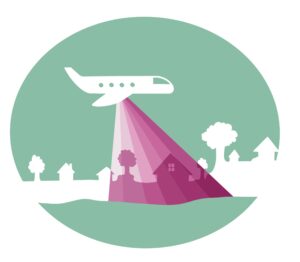
Lidar (/ˈlaɪdɑːr/, also LIDAR, or LiDAR; sometimes LADAR) is a method for determining ranges (variable distance) by targeting an object or a surface with a laser and measuring the time for the reflected light to return to the receiver. It can also be used to make digital 3-D representations of areas on the earth’s surface and ocean bottom by varying the wavelength of light. It has terrestrial, airborne, and mobile applications.
Lidar is an acronym of “Light Detection and Ranging” or “laser imaging, detection, and ranging”. It is sometimes called 3-D laser scanning, a special combination of 3-D scanning and laser scanning.
Lidar is commonly used to make high-resolution maps, with applications in surveying, geodesy, geomatics, archaeology, geography, geology, geomorphology, seismology, forestry, atmospheric physics, laser guidance, airborne laser swath mapping (ALSM), and laser altimetry. It is also used in control and navigation for some autonomous cars and for the Mars helicopter, Ingenuity, on its record-setting flights over the terrain of Mars.
Reference: Wikipedia