
Artificial intelligence (AI) is the ability of a digital computer or computer-controlled robot to perform tasks commonly associated with intelligent beings. The term is frequently applied to developing systems endowed with the intellectual processes characteristic of humans, such as the ability to reason, discover meaning, generalize, or learn from past experience. Since the development of the digital computer in the 1940s, it has been demonstrated that computers can be programmed to carry out very complex tasks with great proficiency, for example, discovering proofs for mathematical theorems or playing chess. Still, despite continuing advances in computer processing speed and memory capacity, there are yet no programs that can match human flexibility over wider domains or in tasks requiring much everyday knowledge. On the other hand, some programs have attained the performance levels of human experts and professionals in performing certain specific tasks, so that artificial intelligence in this limited sense is found in applications as diverse as medical diagnosis, computer search engines, and voice or handwriting recognition.
Reference: Encyclopædia Britannica
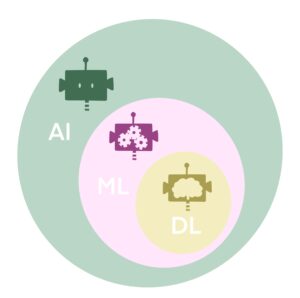
Machine learning (ML) is the study of computer algorithms that can improve automatically through experience and using data. It is seen as a part of artificial intelligence. Machine learning algorithms build a model based on sample data, known as training data, in order to make predictions or decisions without being explicitly programmed to do so. Machine learning algorithms are used in a wide variety of applications, such as in medicine, email filtering, speech recognition, and computer vision, where it is difficult or unfeasible to develop conventional algorithms to perform the needed tasks.
Reference: Wikipedia
Deep learning is a class of machine learning approaches that uses many layers in a graph representation structure to progressively extract higher-level features from the raw input. For example, in image processing, lower layers may identify edges, while higher layers may identify the concepts relevant to a human such as digits or letters or faces. Deep learning is based on artificial neural networks.
Reference: Wikipedia
Artificial Neural network is a computer program that operates in a manner inspired by the neural network of the brain. The objective of such artificial neural networks is to perform cognitive functions, reasoning, and problem solving.
Reference: Wikipedia
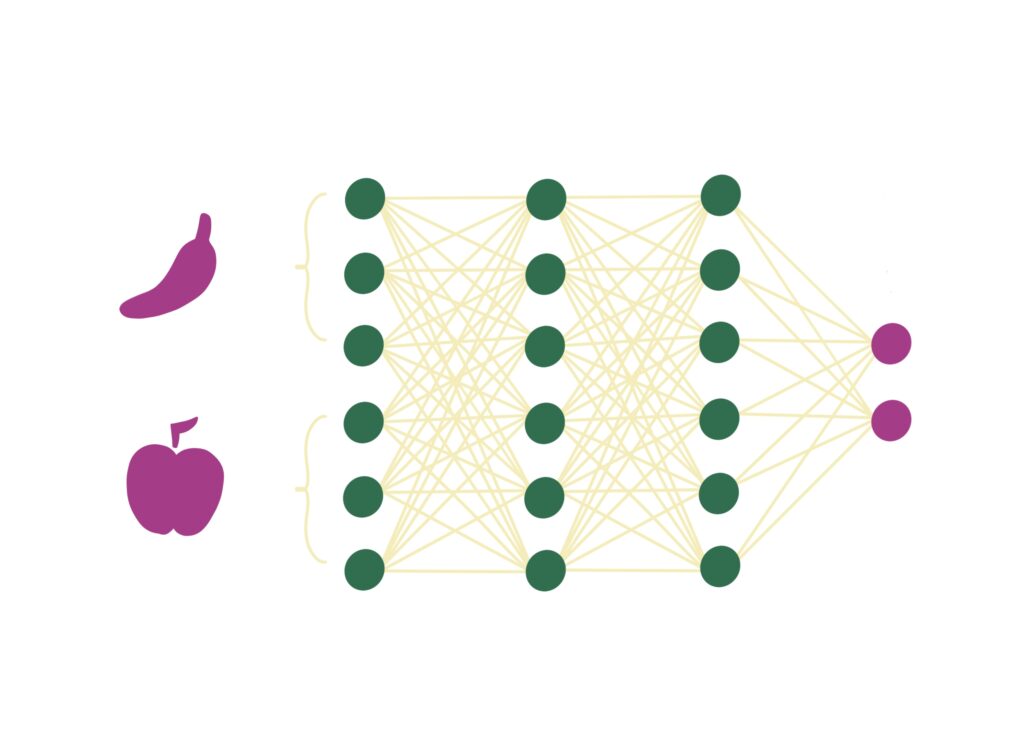
Supervised learning is a machine learning approach that is defined by the use of labeled datasets. These datasets are designed to make use of the labels to train models into classifying data or predicting outcomes. Using labeled inputs and outputs, the model can learn over time in a supervised manner.
Reference: Wikipedia

Unsupervised learning is a machine learning approach defined by the use of unlabeled data sets. These algorithms discover hidden patterns in data without the need for labels or human intervention; hence, they are “unsupervised”.
Reference: Wikipedia

Semi-supervised learning is a machine learning approach that combines a small amount of labeled data with a large amount of unlabeled data during training. Semi-supervised learning falls between unsupervised learning (with no labeled training data) and supervised learning (with only labeled training data). May also be called weak supervised learning.
Reference: Wikipedia
Reinforcement learning is machine learning approach in which a model learns to become more accurate for performing an action in an environment based on feedback that maximizes the reward.
Reference: IBM
